Your astrophotography copilot
Lambda Orionis Ring (Sh2-264)
emission nebula in Orion
The Lambda Orionis Ring is a huge, faint ring of glowing hydrogen around Meissa, the star that marks Orion's head, and the young cluster Collinder 69 at its centre. It is thought to be the remains of a supernova explosion in the cluster about a million years ago. It spans many degrees, so it is a lens or small refractor target, often framed together with Barnard's Loop to its south.
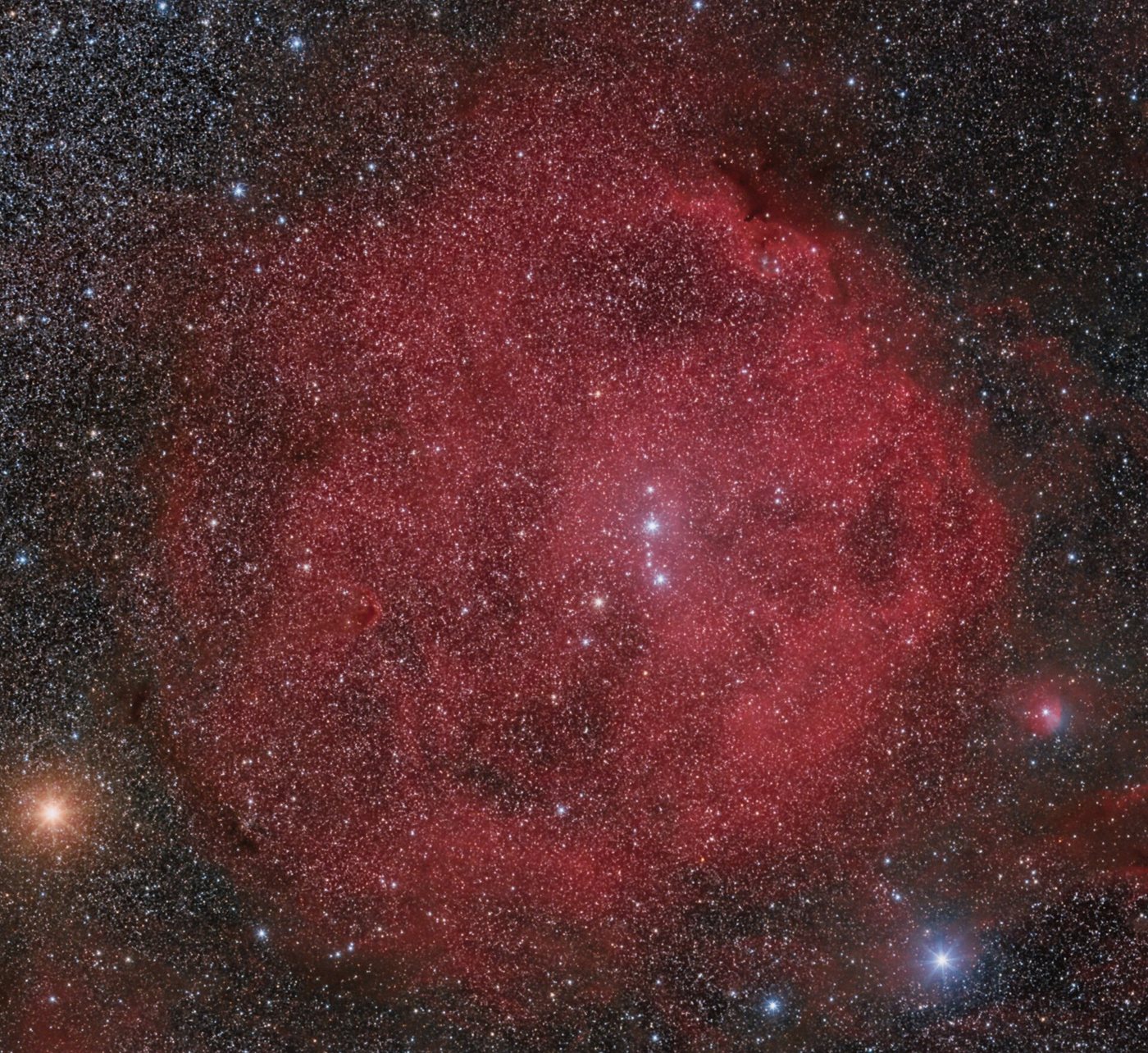
See what others have shot: Lambda Orionis Ring on AstroBin
- Catalog
- Sh2-264
- Also known as
- Sharpless 264, Sh 2-264, Lambda Orionis Nebula, Angelfish Nebula, Collinder 69, Lambda Ori Ring
- Type
- emission nebula
- Constellation
- Orion
- Size
- 8.0° across
- Total light to aim for
- About 8 h (Faint gas without a narrowband filter needs a lot of time. Add your own goal on My targets.)
- Distance
- roughly 1,300 light-years
- Peak month (any location)
- Dec
- Typical prime months
- Sep to Feb
- Difficulty
- Advanced
- Filter
- Narrowband: Ha / OIII / SII, or a dual-band / UHC filter
Save your telescope or lens on the planner to lay your camera frame over this diagram.
Pick a saved location or share your device location. Your coordinates are used only to calculate tonight and are not stored. To save locations, use the planner.
- The ring is roughly 5 to 10 degrees across, depending on how faint an edge you count, so use a 35 to 135 mm lens on a tracker.
- It is dim and low in contrast. Hydrogen-alpha or a dual-band filter, a dark moonless night and several hours of exposure give a result.
- Take good flats and be careful with gradient removal, since the faint ring is easy to subtract by accident.
- Best from November to February, when Orion is high in the evening sky.
The focal length at which Sh2-264 spans about 60% of the long side of the sensor, leaving room around it. Treat it as a starting point; the right framing is a matter of taste.
| Sensor | Focal length |
|---|---|
| 1-inch sensor (13.2 mm) | about 60 mm |
| APS-C (23.5 mm) | about 100 mm |
| Full frame (36 mm) | about 150 mm |
The highest point Sh2-264 reaches in the sky. Above about 60° is excellent, 30° to 60° is workable, and under 30° you are looking through a lot of air.
| Latitude | Highest point | Rating |
|---|---|---|
| 55°N (Scotland, Alaska) | 45° | Workable |
| 45°N (Minneapolis, Milan) | 55° | Workable |
| 35°N (Los Angeles, Tokyo) | 65° | High in the sky |
| 25°N (Miami, Cairo) | 75° | High in the sky |
| 35°S (Sydney, Santiago) | 45° | Workable |
More in Orion
Close to it in the sky
Want a GO / NO-GO verdict for tonight, with clouds, moon, seeing and a full dark-window timeline?
Open the planner