Your astrophotography copilot
Barnard's Loop (Sh2-276)
emission nebula in Orion
Barnard's Loop is a vast, faint arc of glowing hydrogen that wraps around the east side of Orion, from the Belt up past Betelgeuse and down to Rigel. It is the remnant of an ancient shell of gas, blown out by stellar winds and supernovae from the young stars of the Orion region, and the Orion Nebula and Horsehead sit inside it. It is far larger than the field of most telescopes, so it is a widefield and mosaic target, and one of the best-loved winter projects.
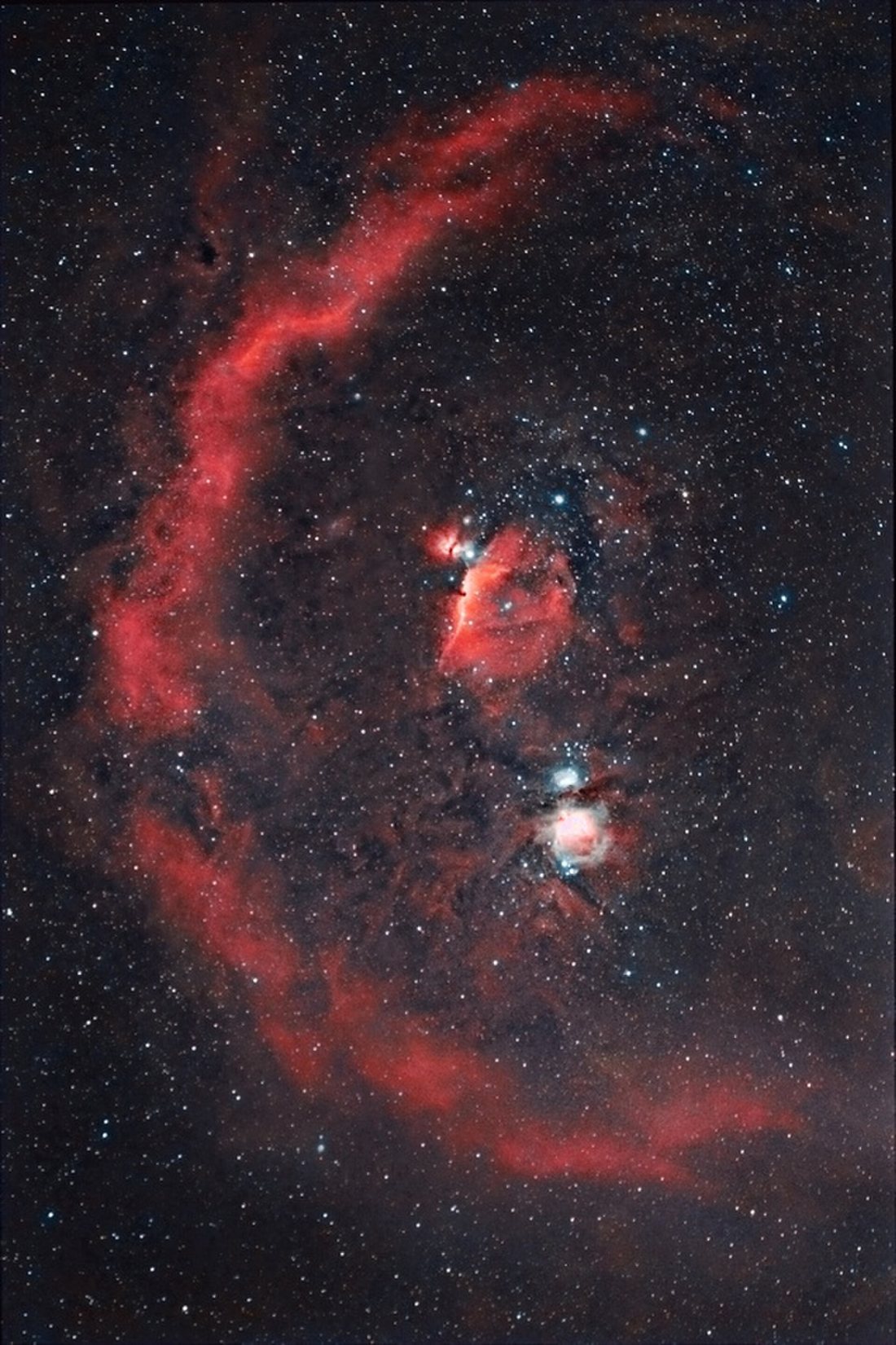
See what others have shot: Barnard's Loop on AstroBin
- Catalog
- Sh2-276
- Also known as
- Sharpless 276, Sh 2-276, Barnard Loop, Orion Loop
- Type
- emission nebula
- Constellation
- Orion
- Size
- 10.0° across
- Total light to aim for
- About 8 h (Faint gas without a narrowband filter needs a lot of time. Add your own goal on My targets.)
- Distance
- roughly 1,300 to 1,600 light-years
- Peak month (any location)
- Dec
- Typical prime months
- Oct to Mar
- Difficulty
- Advanced
- Filter
- Narrowband: Ha / OIII / SII, or a dual-band / UHC filter
Save your telescope or lens on the planner to lay your camera frame over this diagram.
Pick a saved location or share your device location. Your coordinates are used only to calculate tonight and are not stored. To save locations, use the planner.
- It spans roughly 10 degrees or more, so use a lens of about 35 to 135 mm on a tracker, or shoot a mosaic with a short refractor.
- It is very faint and shows almost nothing in a plain camera. Hydrogen-alpha is essential: use a hydrogen-alpha filter or a dual-band filter, and plan several hours of exposure.
- A moonless night and a dark sky matter a great deal. Skyglow and gradients swamp the faint outer arc, so take good flats and remove the gradient carefully.
- It is best from November to February, when Orion is high in the evening sky. Frame it to include M42 or the Horsehead for a sense of scale.
The focal length at which Sh2-276 spans about 60% of the long side of the sensor, leaving room around it. Treat it as a starting point; the right framing is a matter of taste.
| Sensor | Focal length |
|---|---|
| 1-inch sensor (13.2 mm) | about 50 mm |
| APS-C (23.5 mm) | about 80 mm |
| Full frame (36 mm) | about 120 mm |
The highest point Sh2-276 reaches in the sky. Above about 60° is excellent, 30° to 60° is workable, and under 30° you are looking through a lot of air.
| Latitude | Highest point | Rating |
|---|---|---|
| 55°N (Scotland, Alaska) | 33° | Workable |
| 45°N (Minneapolis, Milan) | 43° | Workable |
| 35°N (Los Angeles, Tokyo) | 53° | Workable |
| 25°N (Miami, Cairo) | 63° | High in the sky |
| 35°S (Sydney, Santiago) | 58° | Workable |
More in Orion
Close to it in the sky
Want a GO / NO-GO verdict for tonight, with clouds, moon, seeing and a full dark-window timeline?
Open the planner