Go / no go for deep skyGo / no go for deep sky imaging
Flame Nebula (NGC 2024)
emission nebula in Orion
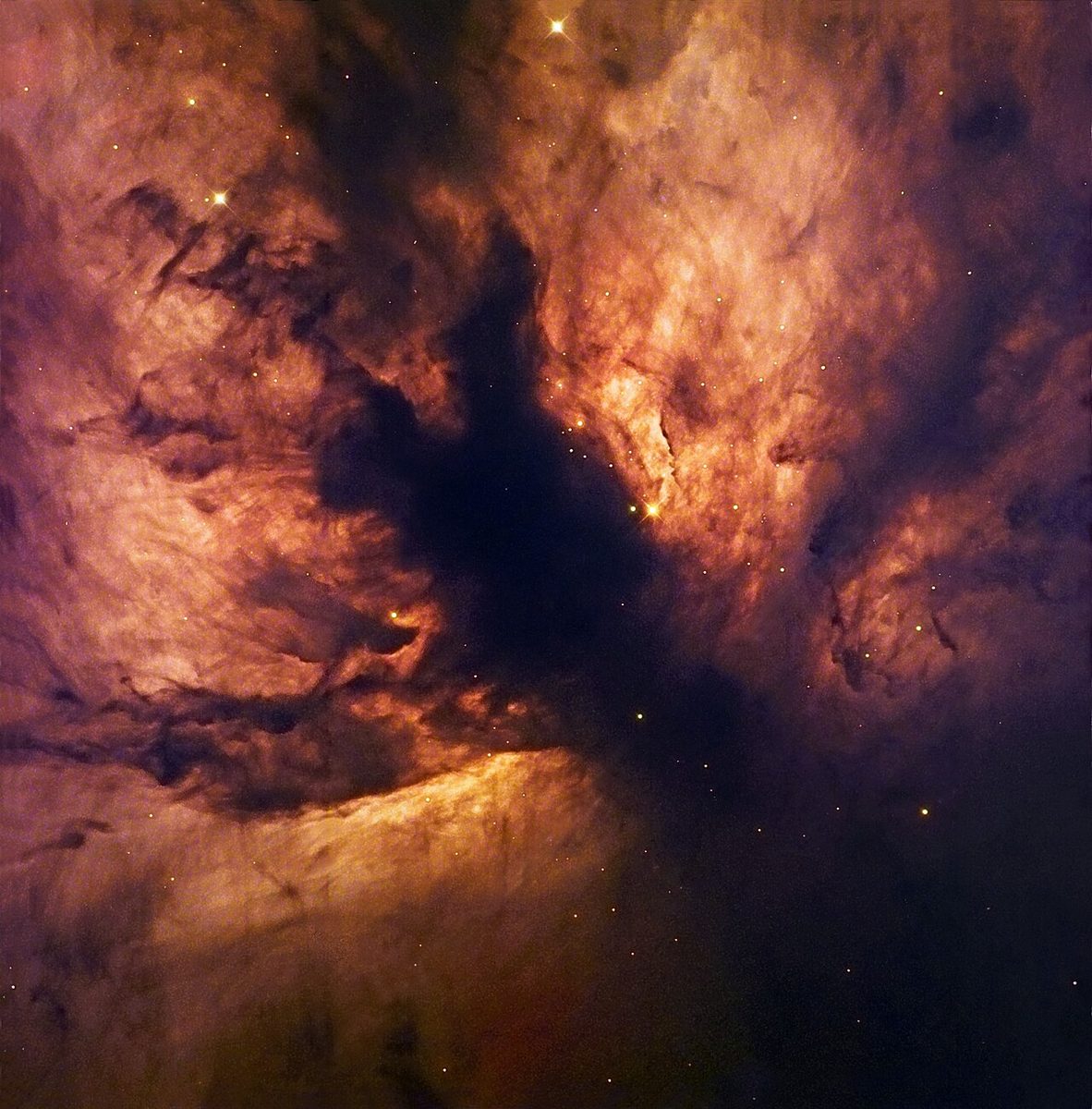
The Flame Nebula is an emission nebula in Orion, right beside the belt star Alnitak. Dark lanes of dust cut through the glow, forming a flame-like pattern, but Alnitak is bright and throws glare across the field.
Save your telescope or lens on the planner to lay your camera frame over this diagram.
// Key facts
- Catalog
- NGC 2024
- Type
- emission nebula
- Constellation
- Orion
- Size
- 30′ across
- Brightness
- Magnitude 7
- Distance
- about 1,400 light-years
- Peak month (any location)
- Dec
- Typical prime months
- Oct to Feb
- Difficulty
- Intermediate
- Filter
- Narrowband: Ha / OIII / SII, or a dual-band / UHC filter
Pick a saved location or share your device location. Your coordinates are used only to calculate tonight and are not stored. To save locations, use the planner.
How to image Flame Nebula
- Ha or a dual-band filter brings out the glow and dust lanes.
- Keep Alnitak out of the field, or deal with halos in processing.
- The Horsehead Nebula is only about half a degree away, so a 1.5-degree frame includes both.
Framing: what focal length?
The focal length at which NGC 2024 spans about 60% of the long side of the sensor, leaving room around it. Treat it as a starting point; the right framing is a matter of taste.
| Sensor | Focal length |
|---|---|
| 1-inch sensor (13.2 mm) | about 910 mm |
| APS-C (23.5 mm) | about 1620 mm |
| Full frame (36 mm) | about 2480 mm |
How high does it climb from your latitude?
The highest point NGC 2024 reaches in the sky. Above about 60° is excellent, 30° to 60° is workable, and under 30° you are looking through a lot of air.
| Latitude | Highest point | Rating |
|---|---|---|
| 55°N (Scotland, Alaska) | 33° | Workable |
| 45°N (Minneapolis, Milan) | 43° | Workable |
| 35°N (Los Angeles, Tokyo) | 53° | Workable |
| 25°N (Miami, Cairo) | 63° | High in the sky |
| 35°S (Sydney, Santiago) | 57° | Workable |
Also worth imaging
Want a GO / NO-GO verdict for tonight, with clouds, moon, seeing and a full dark-window timeline?
Open the planner