Your astrophotography copilot
Leo Triplet (M66 Group)
galaxy group in Leo
The Leo Triplet is three spiral galaxies in a tight knot in Leo: M65 and M66, two tilted spirals about 20 arcminutes apart, and NGC 3628, an edge-on galaxy with a thick dust lane, sitting half a degree north. They are about 35 million light-years away and all fit in a frame under a degree across, which makes this one of the classic galaxy photographs for a medium focal length. It is also called the M66 Group.
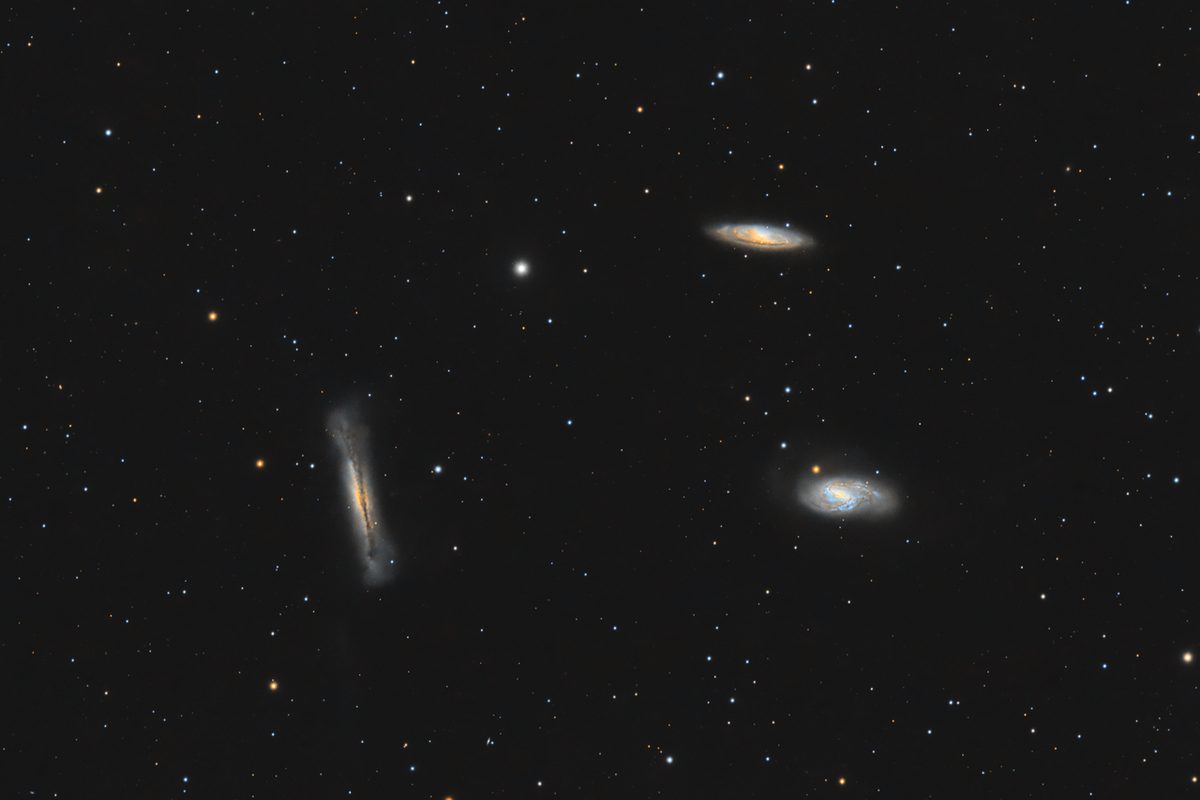
See what others have shot: Leo Triplet on AstroBin
- Catalog
- M66 Group
- Also known as
- M65 Group, M66 Triplet, Leo Triplet, NGC 3628 Group
- Galaxies in it
- M65, M66, NGC 3628 Hamburger Galaxy (see them in your frame)
- Type
- galaxy group
- Constellation
- Leo
- Size
- 48′ across
- Brightness
- Magnitude 8.9
- Total light to aim for
- About 6 h (Galaxies reward long totals. Add your own goal on My targets.)
- Distance
- about 35 million light-years
- Peak month (any location)
- Mar
- Typical prime months
- Dec to May
- Difficulty
- Intermediate
- Filter
- No filter (broadband); a light-pollution filter is optional
Save your telescope or lens on the planner to lay your camera frame over this diagram.
Pick a saved location or share your device location. Your coordinates are used only to calculate tonight and are not stored. To save locations, use the planner.
- A frame 1.5 to 2 degrees wide (roughly 700 to 900 mm on an APS-C camera) holds all three with room around them. The group itself is only about 0.8 degrees tall.
- NGC 3628 has a very faint tidal tail that stretches far to one side. It only shows after many hours of exposure under a dark sky, so treat it as a bonus.
- M66 is the brightest of the three, so expose for the fainter M65 and NGC 3628 and keep the stars from clipping.
- Best from February to May, when Leo is high on spring evenings. It stays well placed from Texas for most of the evening.
- The Leo I Group (M95, M96, M105) is about 8 degrees to the west, so one night can cover both if you move.
The focal length at which M66 Group spans about 60% of the long side of the sensor, leaving room around it. Treat it as a starting point; the right framing is a matter of taste.
| Sensor | Focal length |
|---|---|
| 1-inch sensor (13.2 mm) | about 570 mm |
| APS-C (23.5 mm) | about 1010 mm |
| Full frame (36 mm) | about 1550 mm |
The highest point M66 Group reaches in the sky. Above about 60° is excellent, 30° to 60° is workable, and under 30° you are looking through a lot of air.
| Latitude | Highest point | Rating |
|---|---|---|
| 55°N (Scotland, Alaska) | 48° | Workable |
| 45°N (Minneapolis, Milan) | 58° | Workable |
| 35°N (Los Angeles, Tokyo) | 68° | High in the sky |
| 25°N (Miami, Cairo) | 78° | High in the sky |
| 35°S (Sydney, Santiago) | 42° | Workable |
More in Leo
Close to it in the sky
Want a GO / NO-GO verdict for tonight, with clouds, moon, seeing and a full dark-window timeline?
Open the planner