Go / no go for deep skyGo / no go for deep sky imaging
Little Beehive Cluster (M41)
open cluster in Canis Major
M41 is a bright, large open cluster in Canis Major about four degrees south of Sirius, the brightest star in the sky. It is easy to find, includes a few orange giants among its blue stars, and fills a wide field nicely.
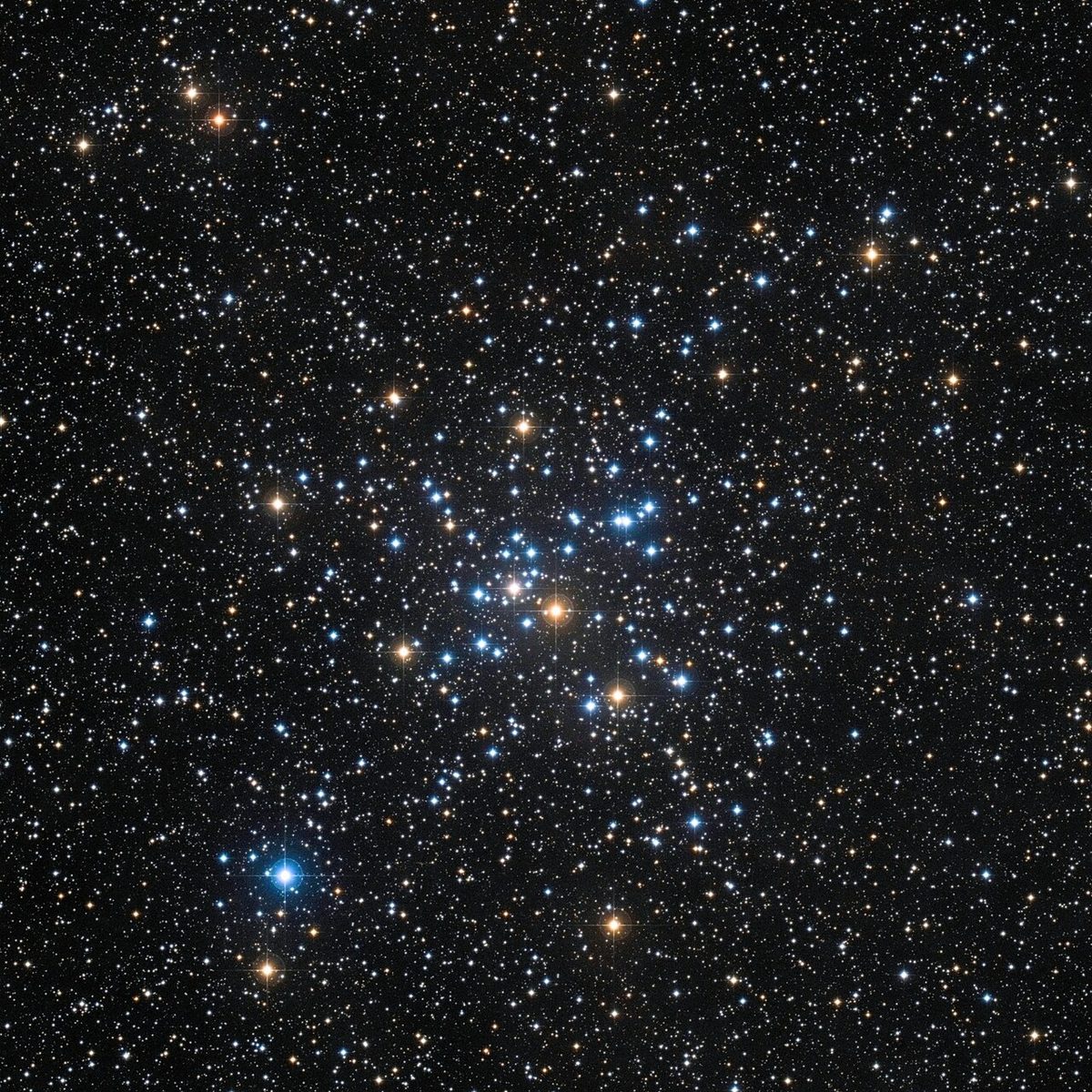
Save your telescope or lens on the planner to lay your camera frame over this diagram.
// Key facts
- Catalog
- M41
- Type
- open cluster
- Constellation
- Canis Major
- Size
- 38′ across
- Brightness
- Magnitude 4.5
- Distance
- about 2,300 light-years
- Peak month (any location)
- Dec
- Typical prime months
- Oct to Mar
- Difficulty
- Beginner
- Filter
- No filter (broadband)
Pick a saved location or share your device location. Your coordinates are used only to calculate tonight and are not stored. To save locations, use the planner.
How to image Little Beehive Cluster
- At 38 arcminutes, 300 to 600 mm is ideal.
- Sirius is very bright, so keep it out of the field to avoid glare.
- Dec -21 makes it moderately low from northern sites in winter.
Framing: what focal length?
The focal length at which M41 spans about 60% of the long side of the sensor, leaving room around it. Treat it as a starting point; the right framing is a matter of taste.
| Sensor | Focal length |
|---|---|
| 1-inch sensor (13.2 mm) | about 720 mm |
| APS-C (23.5 mm) | about 1280 mm |
| Full frame (36 mm) | about 1950 mm |
How high does it climb from your latitude?
The highest point M41 reaches in the sky. Above about 60° is excellent, 30° to 60° is workable, and under 30° you are looking through a lot of air.
| Latitude | Highest point | Rating |
|---|---|---|
| 55°N (Scotland, Alaska) | 14° | Stays low |
| 45°N (Minneapolis, Milan) | 24° | Stays low |
| 35°N (Los Angeles, Tokyo) | 34° | Workable |
| 25°N (Miami, Cairo) | 44° | Workable |
| 35°S (Sydney, Santiago) | 76° | High in the sky |
Also worth imaging
Want a GO / NO-GO verdict for tonight, with clouds, moon, seeing and a full dark-window timeline?
Open the planner