Go / no go for deep skyGo / no go for deep sky imaging
Beehive Cluster (M44)
open cluster in Cancer
The Beehive Cluster, also known as Praesepe, is one of the nearest open clusters, visible to the naked eye as a hazy patch in Cancer. Galileo was among the first to resolve it into stars. It is large enough to need a wide frame.
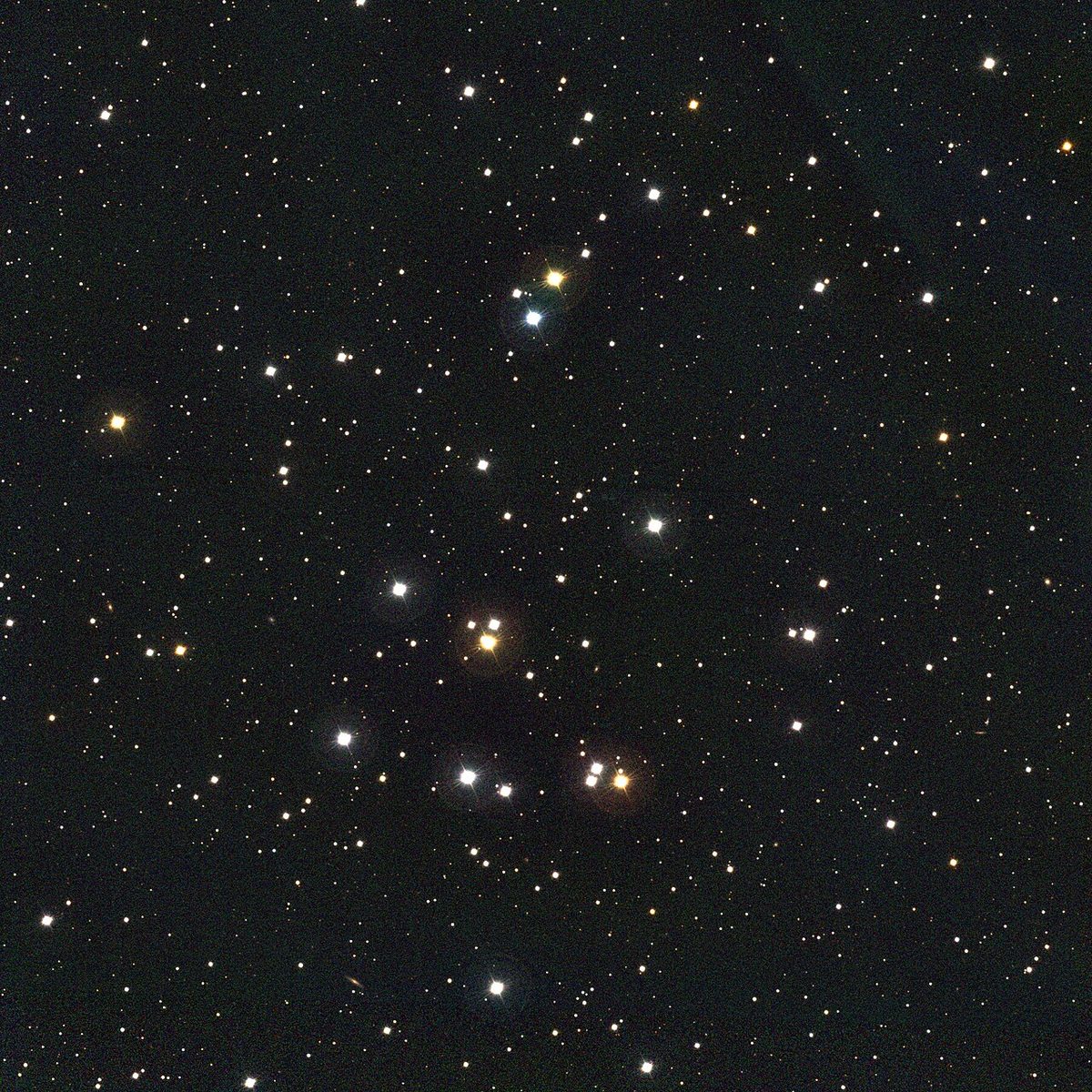
Save your telescope or lens on the planner to lay your camera frame over this diagram.
// Key facts
- Catalog
- M44
- Type
- open cluster
- Constellation
- Cancer
- Size
- 1.6° across
- Brightness
- Magnitude 3.7
- Distance
- about 600 light-years
- Peak month (any location)
- Jan
- Typical prime months
- Nov to Apr
- Difficulty
- Beginner
- Filter
- No filter (broadband)
Pick a saved location or share your device location. Your coordinates are used only to calculate tonight and are not stored. To save locations, use the planner.
How to image Beehive Cluster
- At 95 arcminutes (over 1.5 degrees), use 150 to 300 mm on APS-C.
- Short exposures are enough; the stars are bright and the cluster is easy.
- It is high in the sky on spring evenings from northern sites.
Framing: what focal length?
The focal length at which M44 spans about 60% of the long side of the sensor, leaving room around it. Treat it as a starting point; the right framing is a matter of taste.
| Sensor | Focal length |
|---|---|
| 1-inch sensor (13.2 mm) | about 290 mm |
| APS-C (23.5 mm) | about 510 mm |
| Full frame (36 mm) | about 780 mm |
How high does it climb from your latitude?
The highest point M44 reaches in the sky. Above about 60° is excellent, 30° to 60° is workable, and under 30° you are looking through a lot of air.
| Latitude | Highest point | Rating |
|---|---|---|
| 55°N (Scotland, Alaska) | 55° | Workable |
| 45°N (Minneapolis, Milan) | 65° | High in the sky |
| 35°N (Los Angeles, Tokyo) | 75° | High in the sky |
| 25°N (Miami, Cairo) | 85° | High in the sky |
| 35°S (Sydney, Santiago) | 35° | Workable |
Also worth imaging
Want a GO / NO-GO verdict for tonight, with clouds, moon, seeing and a full dark-window timeline?
Open the planner