Your astrophotography copilot
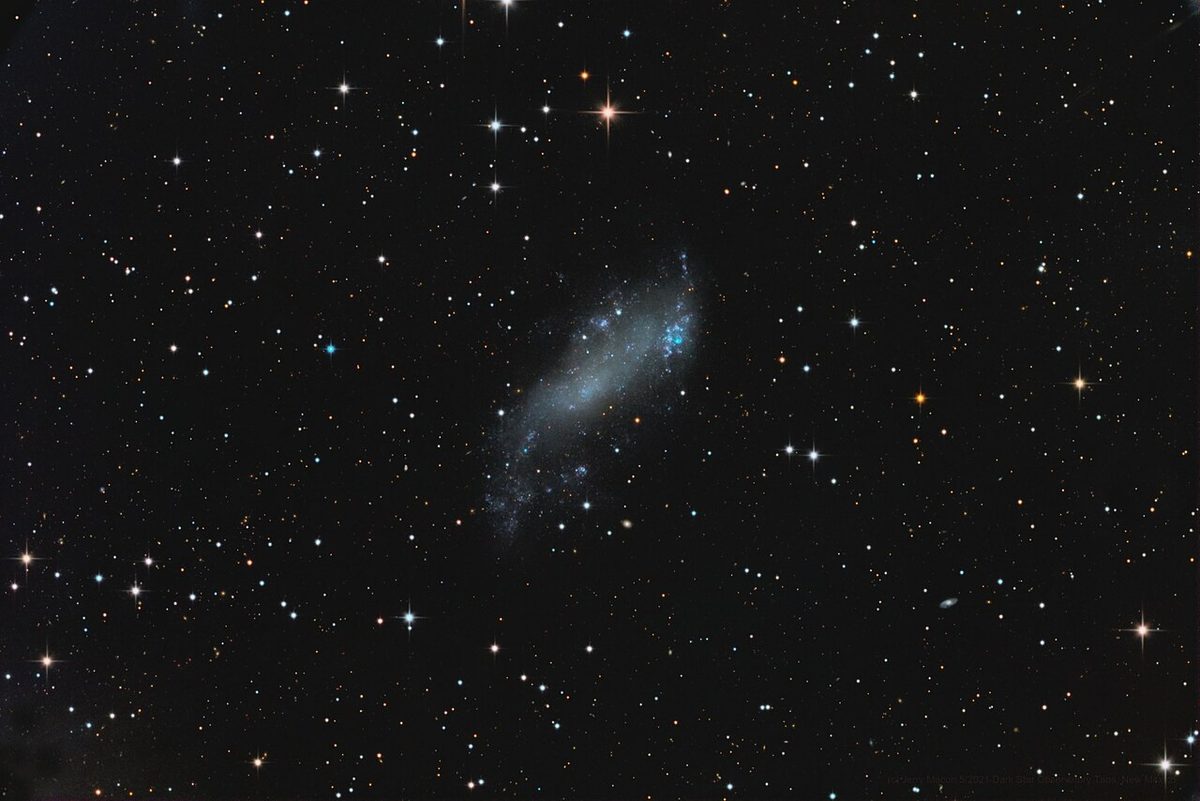
Coddington's Nebula (IC 2574)
irregular galaxy in Ursa Major
Coddington's Nebula (IC 2574) is an irregular galaxy with no regular spiral shape, in the constellation Ursa Major. It measures about 12.9′ across. It shines at about magnitude 10.5, but a galaxy's light is spread over its whole area, so it looks fainter than that number suggests. This page covers when to photograph it, what focal length and filter suit it, and how high it climbs from your latitude.
- Catalog
- IC 2574
- Type
- irregular galaxy
- Constellation
- Ursa Major
- Size
- 12.9′ across
- Brightness
- Magnitude 10.5
- Total light to aim for
- About 10 h (A faint galaxy needs the most time to show its arms.)
- Peak month (any location)
- Feb
- Typical prime months
- Dec to May
- Filter
- No filter (broadband); a light-pollution filter is optional
Data from OpenNGC (CC-BY-SA 4.0). Size and brightness are approximate, and a galaxy’s magnitude is spread over its whole area, so a large faint one is harder than its number suggests.
Pick a saved location or share your device location. Your coordinates are used only to calculate tonight and are not stored. To save locations, use the planner.
The highest point IC 2574 reaches in the sky. Above about 60° is excellent, 30° to 60° is workable, and under 30° you are looking through a lot of air.
| Latitude | Highest point | Rating |
|---|---|---|
| 55°N (Scotland, Alaska) | 77° | High in the sky |
| 45°N (Minneapolis, Milan) | 67° | High in the sky |
| 35°N (Los Angeles, Tokyo) | 57° | Workable |
| 25°N (Miami, Cairo) | 47° | Workable |
| 35°S (Sydney, Santiago) | below horizon | Never rises |
See it in your frame · Open the planner
When to photograph it
Dec to May is the main season, and it is highest in the middle of the night around Feb. Before that it rises in the evening or late night; after it, it sets earlier each week, until it is lost in the evening twilight.
Framing and focal length
At about 12.9′ across it is small, so it needs a long focal length. At 2,000 mm it fills roughly 32% of the long side of an APS-C frame, and a shorter lens would leave it as a small patch in the middle.
Filters, light and the Moon
No filter (broadband); a light-pollution filter is optional. Plan on about 10 h of total exposure to start with. A faint galaxy needs the most time to show its arms. Broadband targets like this are at their best in the dark of the Moon. Plan to image it in the week around new moon.
How hard is it?
Coddington's Nebula is a moderate target. It rewards a tracked mount, a dark sky and a few hours of stacked exposures, but it is within reach of a small refractor.
How high it climbs
The highest it ever climbs is 77° from 55°N, 67° from 45°N, 57° from 35°N, 47° from 25°N, below the horizon from 35°S. It does best from 55°N.
When is the best time to photograph Coddington's Nebula?
Dec to May is the main season, and it is highest in the middle of the night around Feb. Before that it rises in the evening or late night; after it, it sets earlier each week, until it is lost in the evening twilight.
What focal length do I need for Coddington's Nebula?
At about 12.9′ across it is small, so it needs a long focal length. At 2,000 mm it fills roughly 32% of the long side of an APS-C frame, and a shorter lens would leave it as a small patch in the middle.
What filter should I use for Coddington's Nebula?
No filter (broadband); a light-pollution filter is optional.
How long should I expose Coddington's Nebula?
Aim for about 10 h in total as a starting point. A faint galaxy needs the most time to show its arms.