Your astrophotography copilot
Comets
Which comets are worth watching over the next few years, when the famous ones come back, and how to photograph one. Comets are the least predictable thing in the sky, so every brightness here is a forecast and could be off by several magnitudes.
Brightness is measured in magnitudes, and the scale runs backwards: the smaller the number, the brighter the object. Each step of 1 is about 2.5 times brighter, and 5 steps is exactly 100 times. Negative numbers are brighter than zero.
| Magnitude | Example | How you see it |
|---|---|---|
| −26.7 | The Sun | Never look at it without a solar filter. |
| −12.7 | Full Moon | Bright enough to cast shadows and wash out a comet. |
| −4 | Venus at its best | The brightest thing in the sky after the Moon. Visible in daylight if you know where. |
| −1.5 | Sirius | The brightest star. Easy from any city. |
| 0 | Vega, Arcturus | Very bright stars. Easy from any city. |
| 2 | Polaris, the Big Dipper | Clear in a suburb, and the limit of what shows in a bright city. |
| 4 | Faint stars in a dim constellation | Needs a darker sky than most city centers. |
| 6 | Faintest stars in a dark sky | The naked-eye limit under a rural sky. A comet here is a faint smudge. |
| 9 to 10 | Typical binocular limit | 50 mm binoculars on a dark night. |
| 14 to 15 | A cooled camera or 8 inch scope on a good night | Faint comets and galaxies, found by stacking. |
One catch for comets: the magnitude is the total light of the whole fuzzy head, spread over an area, so a comet looks fainter than a star of the same number. A magnitude 6 comet is a faint smudge even in a dark sky, and from a suburb it takes binoculars. As a rule, take about 2 off in a city and expect to need dark skies for anything fainter than 5.
These are the comets forecast to reach binocular brightness or close to it. Dates are the closest approach to the Sun (perihelion), and a comet is usually brightest within a few weeks of it. The figures come from Jonathan Shanklin’s yearly comet forecasts and were checked in October 2026. There is no sure naked-eye comet in the list. The honest summary is a few good binocular comets, and the chance of a surprise.
161P/Hartley-IRAS
Perihelion Nov 28, 2026Forecast peak: magnitude about 9.6 (binoculars or a telescope)Telescope or good binoculars, and fading after its November peak.
2P/Encke
Perihelion Feb 10, 2027Forecast peak: magnitude forecasts range from about 4 to 11 (binoculars)Best in the evening sky in January, when it should be a binocular comet. By perihelion it is lost in the Sun's glare. Forecasts disagree widely.
45P/Honda-Mrkos-Pajdusakova
Perihelion Aug 31, 2027Forecast peak: magnitude about 8.5 (binoculars, at the limit)A short binocular window in the morning sky in August.
255P/Levy
Perihelion Sep 25, 2027Forecast peak: magnitude about 9 (a telescope or camera)Morning sky, a telescope or camera target.
104P/Kowal
Perihelion Oct 13, 2027Forecast peak: magnitude about 10 (a telescope or camera)Morning sky, brightest in late October. A camera target.
96P/Machholz
Perihelion May 12, 2028Forecast peak: magnitude about 2 at best (naked eye if it were not so near the Sun)Brightest only when it is within a few degrees of the Sun, so binoculars at dusk or dawn in late May, if at all.
22P/Kopff
Perihelion Jun 28, 2028Forecast peak: magnitude about 6.6 (binoculars)An evening binocular comet around midsummer, closest to Earth in August.
2026 C1 (Tsuchinshan)
Perihelion Nov 7, 2028Forecast peak: magnitude about 4.8 (possibly naked eye)A new comet, so the forecast is the least reliable here. It may be naked eye from the southern hemisphere, then an evening object in the north in December.
19P/Borrelly
Perihelion Dec 12, 2028Forecast peak: magnitude about 6.5 (binoculars)A good binocular comet. Visible from the south first, and from northern skies from mid-November.
Lower on the list are many fainter comets, such as 67P/Churyumov-Gerasimenko (the Rosetta comet) in April 2028 at about magnitude 13, which a cooled camera can record. And any day a new comet can be found that outshines all of these. The great ones usually are discovered only a few months before they peak.
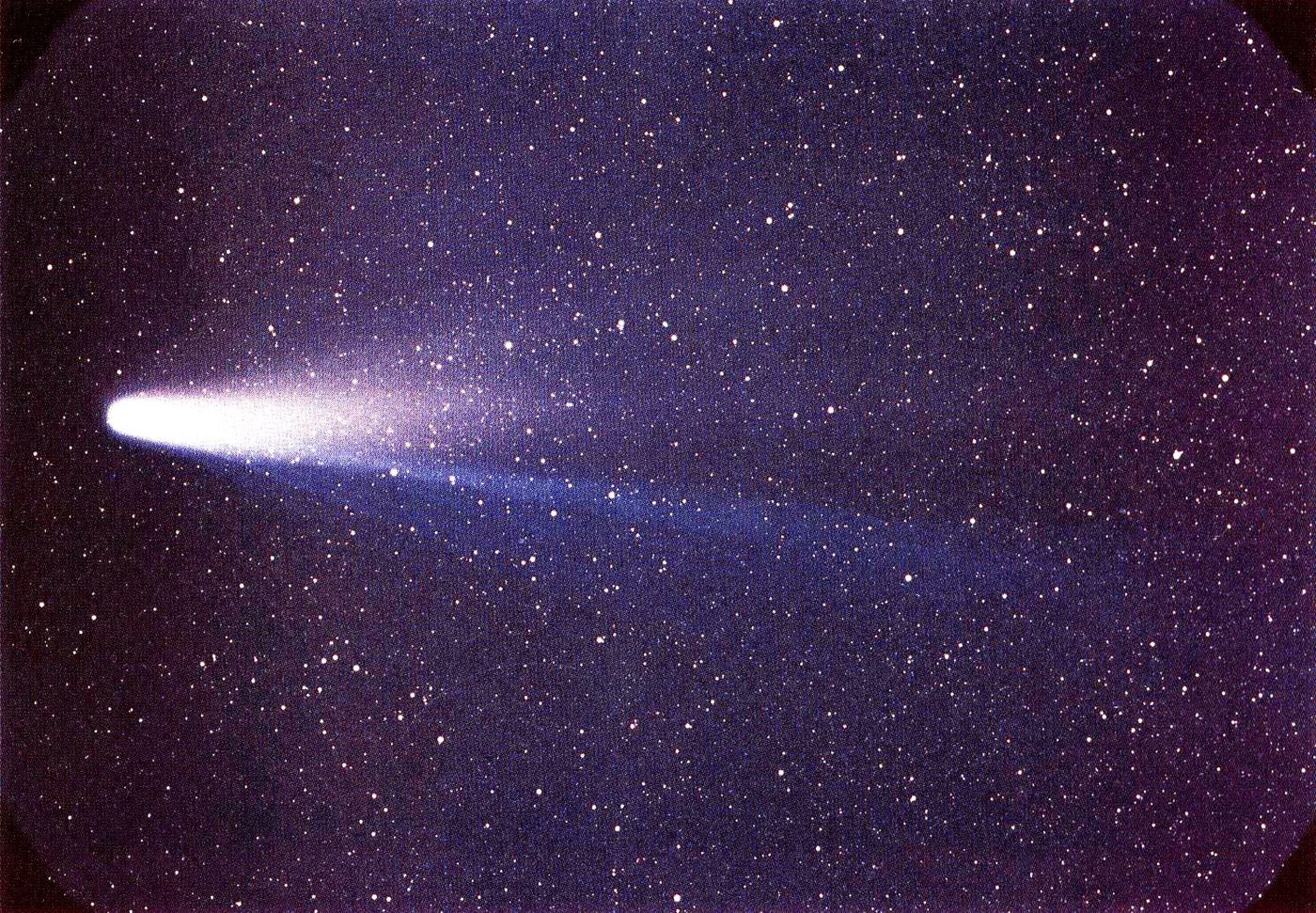
The comets people remember are mostly long-period visitors that will not be back in our lifetimes. Only Halley is on a schedule you can plan a life around.
| Comet | Last seen | Next return | Orbit takes | Peak brightness |
|---|---|---|---|---|
| Halley's Comet (1P/Halley) | 1986 | July 28, 2061 | about 76 years | about +2 in 1986, about 0 in 1910 |
| Hale-Bopp (C/1995 O1) | 1997 | about the year 4385 | about 2,400 years | about −1 |
| NEOWISE (C/2020 F3) | 2020 | about the year 8800 | about 6,800 years | about +1 |
| Hyakutake (C/1996 B2) | 1996 | tens of thousands of years | about 70,000 years | about 0 |
| Tsuchinshan-ATLAS (C/2023 A3) | 2024 | not in any human lifetime | tens of thousands of years or more | about −5, for about a week |
| Pons-Brooks (12P) | 2024 | 2095 | about 71 years | about +5 |
| Swift-Tuttle (109P) | 1992 | July 2126 | about 133 years. It is the parent of the Perseid meteors. | about +5 |
| Encke (2P) | 2023 | February 2027, then about every 3.3 years | about 3.3 years, among the shortest of any comet | about +6 at best |
Returns centuries or thousands of years out are approximate, because planets nudge a comet’s orbit on each pass. Peak brightness figures are approximate and sources differ by a magnitude or more. For comparison, Hale-Bopp was easy to see by eye for about 18 months, while NEOWISE needed a dark sky and a clear northern horizon.
A comet is a deep-sky target that moves. Most of what works for nebulae works here, with a few changes.
- Find it first. A faint comet is hard to find by eye. Take a test shot, or use plate solving or star hopping with its coordinates from a planetarium app for the night.
- Keep the exposures short enough that the comet does not smear. A fast comet near Earth can move noticeably in a minute. If you track on the stars, the comet slowly trails across the frame, so use shorter subs than you would for a nebula.
- Two stacks. Stack once on the stars, for sharp stars and a smeared comet, and once on the comet, for a sharp comet and trailed stars. Blend the two. Siril and PixInsight can both register on a moving object.
- Go wide for a bright comet. A comet with a long tail suits a camera lens of 50 to 200 mm on a tracker. A fainter, smaller comet suits a telescope. Check the framing with the FOV calculator.
- No special filter. A comet is mostly reflected sunlight plus a green glow from gas and a blue ion tail. Use a plain luminance or a color camera, and skip narrowband. A mild light-pollution filter can help from a bright site, but it will dull the colour.
- Mind the Moon and the horizon. Many comets hang low in twilight, so you have a short window and a lot of sky glow. Check when it gets dark and where the Moon is. For setting up, see the exposure calculator and the polar alignment clock.
- Stretch gently. The tail is faint and fine. See the stretching guide and processing for the route.
Never point a camera or telescope at a comet near the Sun without a proper solar filter, and only when the Sun is below the horizon or you are sure it is blocked. A comet close to the Sun is a daytime object for most people.
Dark Window does not track comets night to night, because their positions and brightness change too fast and too unpredictably to give a trustworthy GO / NO-GO. For what is visible this week, with finder charts and recent observers’ brightness estimates, use one of these:
- Comet Chasing lists the comets visible this month by the aperture you need.
- COBS, the Comet Observation Database collects observers’ brightness estimates, so you can see how a comet is really doing.
Once you have a target, check the night on the planner and the Moon on the dark calendar.
- When is the next Hale-Bopp?
- Not for a very long time. Hale-Bopp came through in 1997 and takes roughly 2,400 years to return, so its next close pass is around the year 4385. Nobody alive now will see it again. Comets that are bright from a long way out, like Hale-Bopp, are almost always long-period comets on their first or rare visit, which is why a new one can appear with only months of warning.
- When is Halley's Comet back?
- Halley reaches its closest point to the Sun on July 28, 2061. It was last here in 1986, a poor apparition for the northern hemisphere. 2061 should be a little better, but Halley is a modest comet, not the great show it has in history books. Its dust makes the Orionid and Eta Aquarid meteor showers every year, and you can plan for those on the meteors page.
- Will there be another comet like NEOWISE?
- Probably, but nobody can say when. NEOWISE was found in March 2020 and reached naked-eye brightness in July 2020. Comets that bright are rare, on the order of one every several years to a decade, and they usually give only a few months of notice.
- How bright does a comet need to be to see?
- Magnitude 6 or brighter is naked eye in a dark sky, but a comet's light is spread over a fuzzy head, so it looks much fainter than a star of the same magnitude. A comet at magnitude 8 to 10 needs binoculars or a telescope, and magnitude 10 to 14 is a camera target. A camera on a tracker will pick up a comet that you cannot see by eye.
- Why are comet forecasts so unreliable?
- A comet is a lump of ice and dust, and how bright it gets depends on how fast it sheds gas as it warms, which you cannot know until it does it. New comets are the worst: many promise a lot and fade, and a few outburst and surprise. Comets that have been seen before, like Encke or Borrelly, are more reliable, but even they vary by several magnitudes from one return to the next. Treat any brightness figure as a guess.
- Is a comet the same as a meteor shower?
- No, but they are related. A comet leaves a trail of dust along its orbit. When Earth passes through that trail, the dust burns up as a meteor shower. Swift-Tuttle makes the Perseids and Halley makes the Orionids and Eta Aquarids. The meteors page lists the peaks and the Moon on each. Meteor showers.
Forecasts: Jonathan Shanklin, Comet Section of the British Astronomical Association, as checked in October 2026.