Go / no go for deep skyGo / no go for deep sky imaging
Pleiades (M45)
open cluster in Taurus
The Pleiades are a young open cluster of hot blue stars, wrapped in a veil of reflected blue dust. The stars are easy; the dust is the challenge. The cluster spans over a degree, so it suits short focal lengths and wide fields, and it rides high in the autumn and winter evening sky.
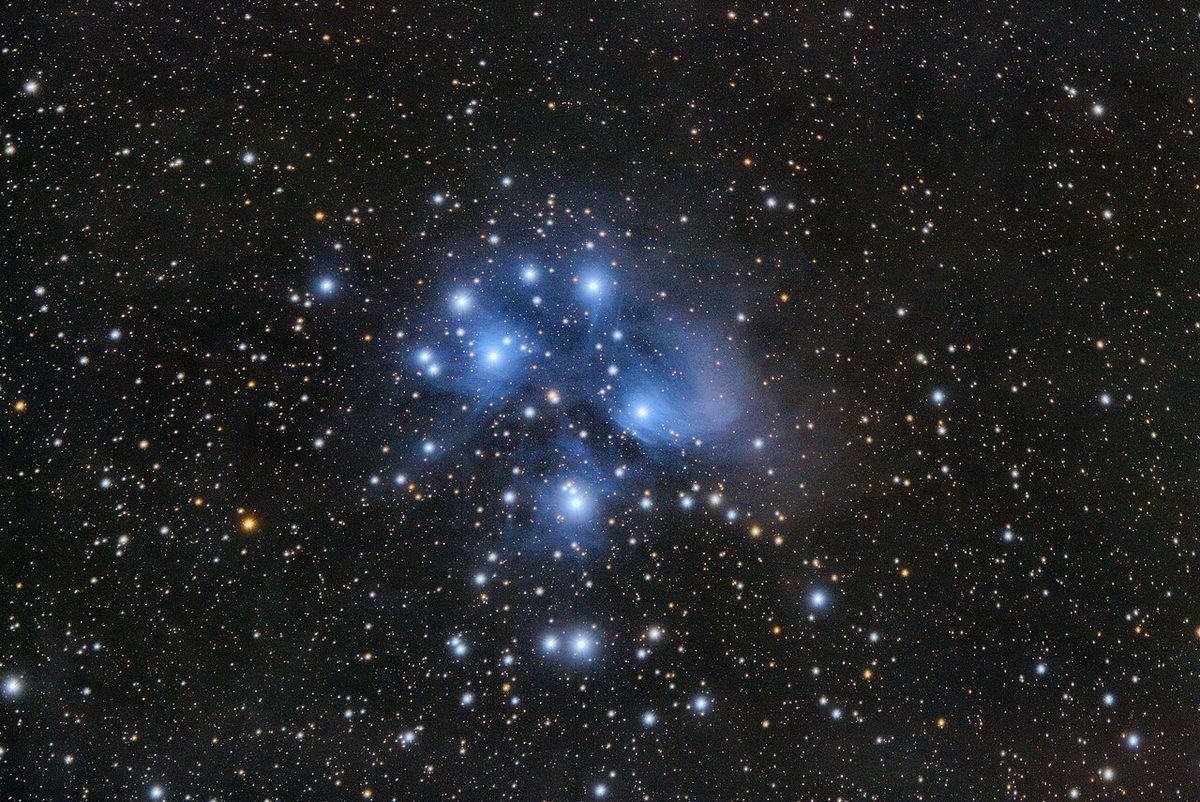
Save your telescope or lens on the planner to lay your camera frame over this diagram.
// Key facts
- Catalog
- M45
- Type
- open cluster
- Constellation
- Taurus
- Size
- 1.8° across
- Brightness
- Magnitude 1.6
- Distance
- about 440 light-years
- Peak month (any location)
- Nov
- Typical prime months
- Sep to Jan
- Difficulty
- Intermediate
- Filter
- No filter (broadband)
Pick a saved location or share your device location. Your coordinates are used only to calculate tonight and are not stored. To save locations, use the planner.
How to image Pleiades
- The dust is faint and wide, so total exposure time matters more here than for most clusters. Aim for several hours if you want the wisps to show.
- Bright stars bloat easily. Good focus and a round-star lens or scope help the nebulosity stand out.
- Avoid a light-pollution filter that shifts the blue. The dust shines by reflected starlight and needs broad color.
Framing: what focal length?
The focal length at which M45 spans about 60% of the long side of the sensor, leaving room around it. Treat it as a starting point; the right framing is a matter of taste.
| Sensor | Focal length |
|---|---|
| 1-inch sensor (13.2 mm) | about 250 mm |
| APS-C (23.5 mm) | about 440 mm |
| Full frame (36 mm) | about 670 mm |
How high does it climb from your latitude?
The highest point M45 reaches in the sky. Above about 60° is excellent, 30° to 60° is workable, and under 30° you are looking through a lot of air.
| Latitude | Highest point | Rating |
|---|---|---|
| 55°N (Scotland, Alaska) | 59° | Workable |
| 45°N (Minneapolis, Milan) | 69° | High in the sky |
| 35°N (Los Angeles, Tokyo) | 79° | High in the sky |
| 25°N (Miami, Cairo) | 89° | High in the sky |
| 35°S (Sydney, Santiago) | 31° | Workable |
Also worth imaging
Want a GO / NO-GO verdict for tonight, with clouds, moon, seeing and a full dark-window timeline?
Open the planner