Go / no go for deep skyGo / no go for deep sky imaging
M4
globular cluster in Scorpius
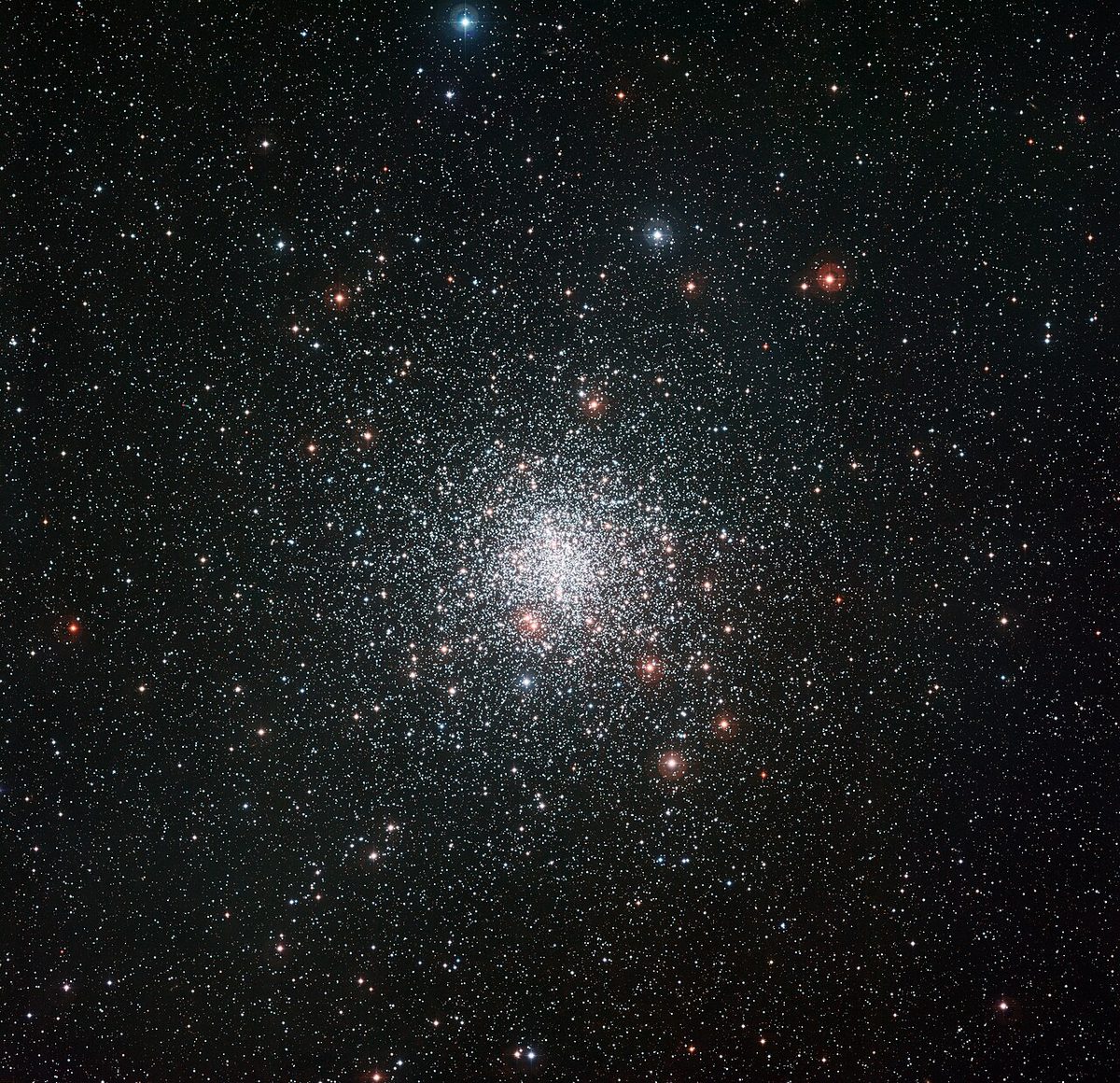
M4 is one of the closest globular clusters to us, so its stars are easy to resolve, even in modest telescopes. It lies just west of the red supergiant Antares in Scorpius, and a faint bar of stars runs across its looser core. Antares and its colorful surroundings can share a wide frame with it.
Save your telescope or lens on the planner to lay your camera frame over this diagram.
// Key facts
- Catalog
- M4
- Type
- globular cluster
- Constellation
- Scorpius
- Size
- 36′ across
- Brightness
- Magnitude 5.6
- Distance
- about 7,200 light-years
- Peak month (any location)
- May
- Typical prime months
- Mar to Aug
- Difficulty
- Intermediate
- Filter
- No filter (broadband)
Pick a saved location or share your device location. Your coordinates are used only to calculate tonight and are not stored. To save locations, use the planner.
How to image M4
- It is low in the sky from the northern United States and Europe, so a clear southern horizon and a still night matter more than usual.
- Because it is so close and loose, it resolves into stars rather than a hazy ball, and rewards a longer focal length.
- Antares is very bright and can add a halo to wider frames, so keep it just outside the field if you want a clean result.
Framing: what focal length?
The focal length at which M4 spans about 60% of the long side of the sensor, leaving room around it. Treat it as a starting point; the right framing is a matter of taste.
| Sensor | Focal length |
|---|---|
| 1-inch sensor (13.2 mm) | about 760 mm |
| APS-C (23.5 mm) | about 1350 mm |
| Full frame (36 mm) | about 2060 mm |
How high does it climb from your latitude?
The highest point M4 reaches in the sky. Above about 60° is excellent, 30° to 60° is workable, and under 30° you are looking through a lot of air.
| Latitude | Highest point | Rating |
|---|---|---|
| 55°N (Scotland, Alaska) | 8° | Stays low |
| 45°N (Minneapolis, Milan) | 18° | Stays low |
| 35°N (Los Angeles, Tokyo) | 28° | Stays low |
| 25°N (Miami, Cairo) | 38° | Workable |
| 35°S (Sydney, Santiago) | 82° | High in the sky |
Also worth imaging
Want a GO / NO-GO verdict for tonight, with clouds, moon, seeing and a full dark-window timeline?
Open the planner