Go / no go for deep skyGo / no go for deep sky imaging
M39
open cluster in Cygnus
M39 is a large, sparse open cluster in Cygnus, roughly triangular, with bright stars spread widely. It is close, so the stars seem scattered rather than concentrated, and it suits a wide field.
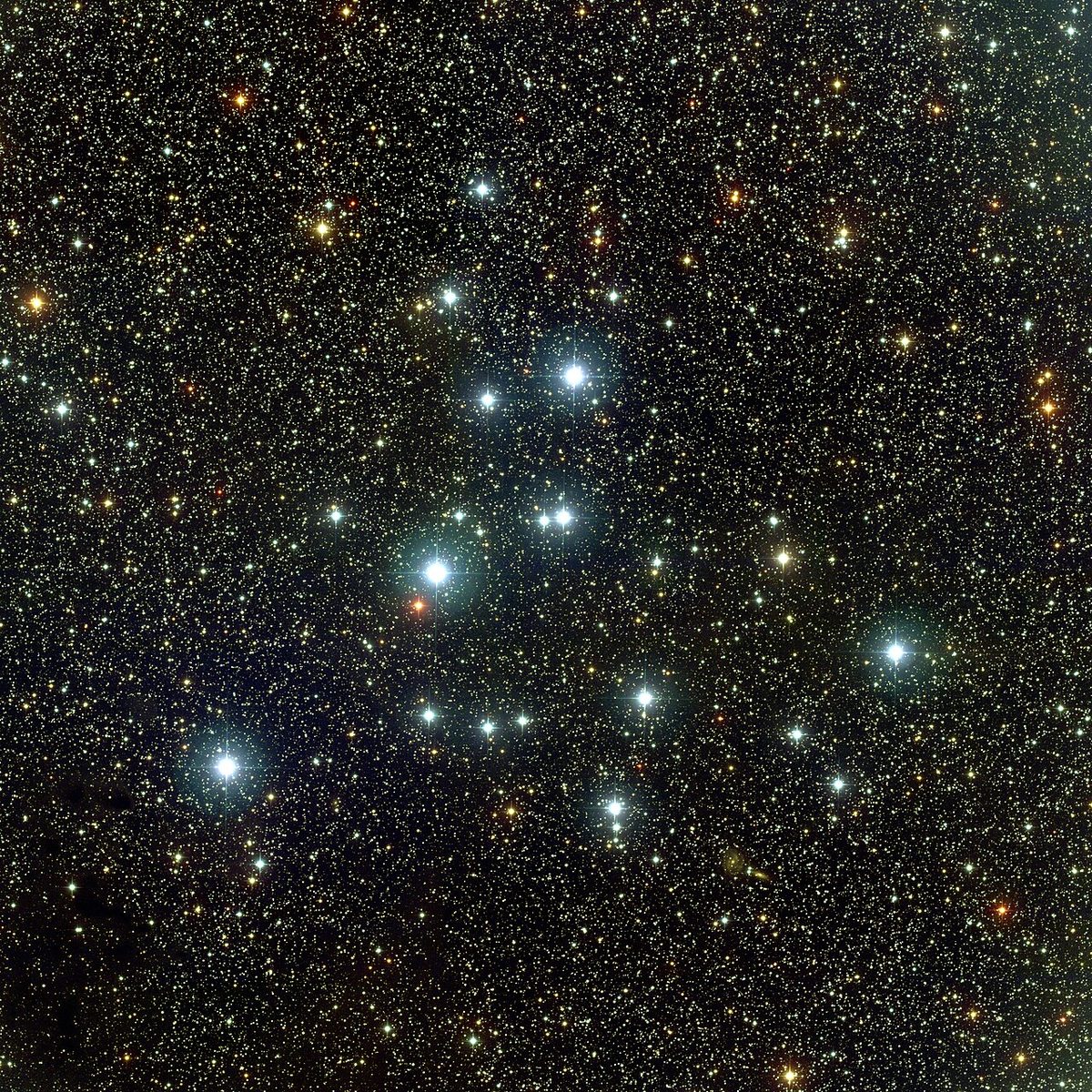
Save your telescope or lens on the planner to lay your camera frame over this diagram.
// Key facts
- Catalog
- M39
- Type
- open cluster
- Constellation
- Cygnus
- Size
- 32′ across
- Brightness
- Magnitude 4.6
- Distance
- about 800 light-years
- Peak month (any location)
- Aug
- Typical prime months
- May to Oct
- Difficulty
- Beginner
- Filter
- No filter (broadband)
Pick a saved location or share your device location. Your coordinates are used only to calculate tonight and are not stored. To save locations, use the planner.
How to image M39
- At 32 arcminutes, 300 to 600 mm gives the cluster room.
- Cygnus is high in the northern summer sky.
- It is a good wide-field target when the nebulae nearby are washed out by the moon.
Framing: what focal length?
The focal length at which M39 spans about 60% of the long side of the sensor, leaving room around it. Treat it as a starting point; the right framing is a matter of taste.
| Sensor | Focal length |
|---|---|
| 1-inch sensor (13.2 mm) | about 850 mm |
| APS-C (23.5 mm) | about 1510 mm |
| Full frame (36 mm) | about 2320 mm |
How high does it climb from your latitude?
The highest point M39 reaches in the sky. Above about 60° is excellent, 30° to 60° is workable, and under 30° you are looking through a lot of air.
| Latitude | Highest point | Rating |
|---|---|---|
| 55°N (Scotland, Alaska) | 83° | High in the sky |
| 45°N (Minneapolis, Milan) | 87° | High in the sky |
| 35°N (Los Angeles, Tokyo) | 77° | High in the sky |
| 25°N (Miami, Cairo) | 67° | High in the sky |
| 35°S (Sydney, Santiago) | 7° | Stays low |
Also worth imaging
Want a GO / NO-GO verdict for tonight, with clouds, moon, seeing and a full dark-window timeline?
Open the planner