Go / no go for deep skyGo / no go for deep sky imaging
Andromeda Galaxy (M31)
spiral galaxy in Andromeda
The Andromeda Galaxy is the nearest large galaxy to the Milky Way and, at roughly three degrees long, the biggest galaxy target most imagers can reach. It is bright enough to show in a short exposure from a suburban yard, which makes it the classic first deep-sky photograph. Its two companion galaxies, M32 and M110, sit in the same frame.
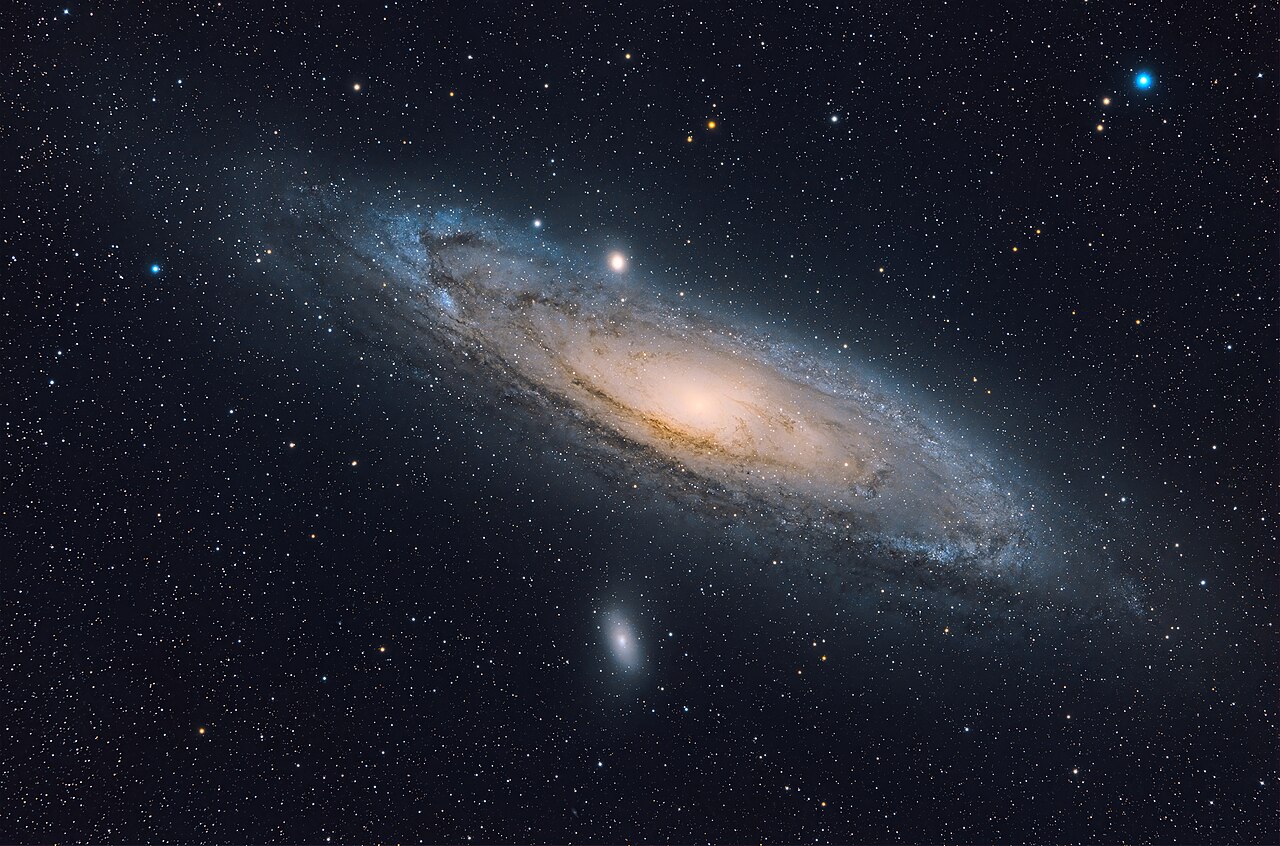
Save your telescope or lens on the planner to lay your camera frame over this diagram.
// Key facts
- Catalog
- M31
- Type
- spiral galaxy
- Constellation
- Andromeda
- Size
- 3.2° across
- Brightness
- Magnitude 3.4
- Distance
- about 2.5 million light-years
- Peak month (any location)
- Sep
- Typical prime months
- Jul to Dec
- Difficulty
- Beginner
- Filter
- No filter (broadband); a light-pollution filter is optional
Pick a saved location or share your device location. Your coordinates are used only to calculate tonight and are not stored. To save locations, use the planner.
How to image Andromeda Galaxy
- It needs a wide frame: about 200 to 300 mm on an APS-C camera fits the whole galaxy with its companions.
- The core is much brighter than the spiral arms and clips easily. Take a few short exposures as well and blend them in so the center keeps its detail.
- The dust lanes are the reward for longer total exposure and a dark sky. Moonlight washes them out quickly, so wait for a moonless window.
Framing: what focal length?
The focal length at which M31 spans about 60% of the long side of the sensor, leaving room around it. Treat it as a starting point; the right framing is a matter of taste.
| Sensor | Focal length |
|---|---|
| 1-inch sensor (13.2 mm) | about 140 mm |
| APS-C (23.5 mm) | about 260 mm |
| Full frame (36 mm) | about 390 mm |
How high does it climb from your latitude?
The highest point M31 reaches in the sky. Above about 60° is excellent, 30° to 60° is workable, and under 30° you are looking through a lot of air.
| Latitude | Highest point | Rating |
|---|---|---|
| 55°N (Scotland, Alaska) | 76° | High in the sky |
| 45°N (Minneapolis, Milan) | 86° | High in the sky |
| 35°N (Los Angeles, Tokyo) | 84° | High in the sky |
| 25°N (Miami, Cairo) | 74° | High in the sky |
| 35°S (Sydney, Santiago) | 14° | Stays low |
Also worth imaging
Want a GO / NO-GO verdict for tonight, with clouds, moon, seeing and a full dark-window timeline?
Open the planner